
 By Alexandra Harper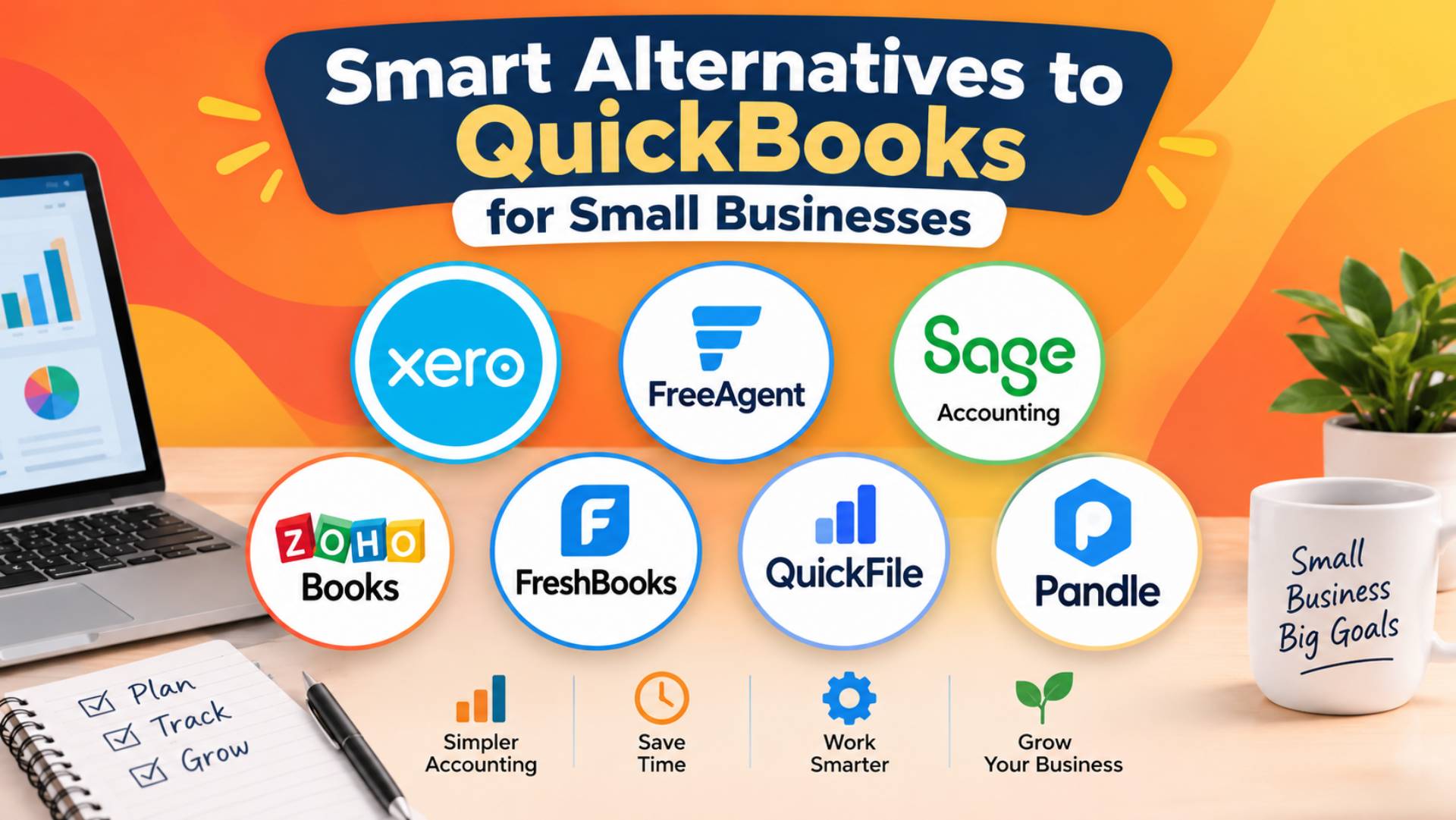
If you’re a UK small business comparing QuickBooks Alternatives, the strongest options are Xero, FreeAgent, Sage Accounting, Zoho Books, FreshBooks, QuickFile and Pandle. Each takes a different approach — some are built for sole traders on a budget, while others suit limited companies that need built-in payroll or multi-currency support. This list compares them on price, Making Tax Digital (MTD) readiness, and who each one genuinely suits, based on publicly available pricing and feature information from each provider’s website. The right choice depends on your business structure, invoice volume and whether you manage bookkeeping yourself or with an accountant.
This article does not accept payment for inclusion or ranking of the accounting software platforms listed above, and none of them are clients, partners or advertisers of this publication as of the time of writing. Readers should independently verify pricing, features and terms directly with each provider before signing up.
7 Best QuickBooks Alternatives at a Glance
| Platform | Best For | Key Strength | Starting Price (UK, ex. VAT) |
|---|---|---|---|
| Xero | Businesses working closely with an accountant | Large third-party app ecosystem | From £18/month (standard rate) |
| FreeAgent | Sole traders/freelancers with NatWest, RBS or Mettle | Free with an eligible bank account | Free, or from £19/month |
| Sage Accounting | Businesses that need payroll built in | Integrated payroll from entry paid tier | Free (Sole Trader), or from £20/month |
| Zoho Books | Cost-conscious businesses wanting full features | MTD-ready free plan | Free, or from £12/month |
| FreshBooks | Service businesses billing clients directly | Client-facing invoicing and project tracking | From £16/month (standard rate) |
| QuickFile | Very low-volume micro-businesses | Free for up to 1,000 ledger entries/year | Free, or from ~£60 + VAT/year |
| Pandle | Businesses wanting unlimited free bookkeeping | No usage limits on the free tier | Free, or £5/month (Pro) |
This list is based on editorial research and publicly available information from official provider websites, HMRC guidance, and independent UK accounting software reviews, correct at the time of writing. None of the platforms listed were purchased, tested or used hands-on by our editorial team for this article. Software features, pricing, free-plan eligibility and MTD requirements change over time, so readers should confirm current details directly with each provider, and with HMRC for filing obligations, before making a decision or entering into a contract.
How We Selected These Accounting Platforms
To identify the best QuickBooks Alternatives, we used editorial research from each provider’s official pricing pages, HMRC’s Making Tax Digital software guidance, and independent UK accounting software reviews. We prioritised platforms relevant to UK small businesses: HMRC-recognised MTD support, transparent published pricing, and a clear target user (sole trader, limited company, freelancer, or service business). We did not test or purchase these products directly; assessments are based on publicly documented features and pricing rather than hands-on use. We excluded platforms without clear UK pricing or MTD compatibility.
1. Xero — Best for Businesses Working Closely With an Accountant
Xero is one of the UK’s most widely used small business Accounting Software options and a natural first stop for anyone leaving QuickBooks, thanks to its large network of connected accountants, bookkeepers and third-party apps, thanks to its large network of connected accountants, bookkeepers and third-party apps. It’s included here because of that ecosystem breadth and its strong reputation among UK practices. It’s best suited to businesses that already work with, or plan to work with, an accountant who uses Xero day to day. Standout features include unlimited users on paid plans, multi-currency support from the Comprehensive tier up, and built-in VAT/MTD filing. One thing to know: the entry-level Ignite plan caps invoicing at 20 invoices and 10 bills a month, so higher-volume businesses will need to step up to Grow or above.
For small businesses comparing QuickBooks alternatives, the software choice is only one part of keeping finance operations organised. Megri Accounting UK supports businesses with outsourced bookkeeping, payroll, VAT and cloud accounting, showing how external finance support can complement the right accounting platform and reduce day-to-day back-office workload.
2. FreeAgent — Best for Sole Traders and Freelancers
FreeAgent is a UK-built accounting platform, now owned by NatWest Group, aimed specifically at sole traders, freelancers and small limited companies. It earns a place among Accounting Software for small businesses because it offers a genuinely free route: it’s free indefinitely for anyone holding a NatWest, Royal Bank of Scotland, Ulster Bank or Mettle business account. It’s best suited to freelancers and micro-businesses who already bank with one of those providers, or who are open to switching. Standout features include built-in self-assessment estimates and time tracking. Worth knowing: without an eligible account, standard pricing runs from roughly £19/month for sole traders up to £33/month for limited companies, so the free offer is central to its value.
3. Sage Accounting — Best for Businesses That Need Payroll Built In
Among established QuickBooks Competitors, Sage is a long-standing UK accounting software brand whose cloud Accounting product bundles payroll options that some rivals treat as a separate add-on. It’s included here for that combination of payroll, invoicing and VAT filing under one subscription, plus a genuinely free entry tier for very small invoicing needs. It’s best suited to small businesses that want payroll handled inside the same platform as their bookkeeping, rather than via a separate tool. Standout features include AI-assisted bookkeeping (Sage Copilot) from the Start tier and final accounts preparation. Worth knowing: multi-user access and custom reporting are reserved for the Standard (£43/month) and Plus (£59/month) tiers, so costs increase quickly for growing teams.
4. Zoho Books — Best for Cost-Conscious Businesses Wanting Full Features
Zoho Books is part of the wider Zoho software suite and stands out for offering a free plan that is genuinely usable rather than a stripped-down trial. Among Alternatives to QuickBooks, Zoho Books stands out because its free tier supports MTD for Income Tax and VAT filing, along with self-assessment forms, at no cost.— an unusual combination in this market. It’s best suited to sole traders and very small businesses that want full MTD compliance without a subscription, or growing businesses wanting Zoho’s broader CRM and invoicing ecosystem. Worth knowing: multi-user collaboration and workflow automation require the Standard plan (£12/month) or above, so the free tier suits single-user setups specifically.
5. FreshBooks — Best for Service Businesses Billing Clients Directly
FreshBooks leans toward invoicing and client management rather than pure bookkeeping, which makes it a strong fit for consultants, agencies and contractors who bill clients directly. It’s included here for that client-facing focus — proposals, retainers and project profitability tracking are more developed than in most bookkeeping-first platforms. Among affordable Accounting Tools, FreshBooks is best suited to service businesses where client billing, rather than stock or heavy transaction volume, is the main workload. Standout features include MTD-compliant VAT returns across all plans. Worth knowing: the entry Lite plan caps billable clients at five, which agencies with a broader client base will outgrow quickly, requiring a move to Plus (50 clients) or Premium (unlimited).
6. QuickFile — Best for Very Low-Volume Micro-Businesses
QuickFile is UK Accounting Software for small businesses that has offered free accounting to smaller firms for more than a decade, rather than using “free” as a short-term trial hook.. It’s included here because it remains genuinely free for most micro-businesses, based on transaction volume rather than a stripped feature set. It’s best suited to sole traders, side businesses and low-volume limited companies. Standout features include MTD for VAT support and MTD for Income Tax readiness. Worth knowing: the free tier covers up to 1,000 nominal ledger entries across a rolling 12 months; businesses that grow past that move to a paid tier starting at roughly £60 plus VAT per year, so cost scales with activity rather than features.
7. Pandle — Best for Businesses Wanting Unlimited Free Bookkeeping
Pandle is a UK cloud bookkeeping platform with one of the more generous free tiers in this market: no usage limits, combined with HMRC-recognised MTD submissions for both VAT and Income Tax. Among QuickBooks Replacement Options, Pandle stands out as a genuinely free-forever choice rather than a capped or time-limited one, which distinguishes it from several competitors. It’s best suited to small businesses and bookkeepers who want unlimited free bookkeeping with a low-cost upgrade path. Standout feature: Pandle Pro costs £5 per month plus VAT, one of the lowest-priced upgrades in the category. Worth knowing: automatic bank feeds are a Pro-only feature — free-tier users import transactions manually, so check this against your workflow before committing.
Review Disclaimer
pick Xero if you work closely with an accountant or need a broad app ecosystem, FreeAgent if you are a freelancer or sole trader with an eligible NatWest, RBS, Ulster Bank or Mettle account, Sage Accounting if built-in payroll matters, Zoho Books if you want strong features at a low cost, FreshBooks if client invoicing is central to your business, QuickFile for very low transaction volumes, and Pandle if you want unlimited free bookkeeping. Compare MTD support, usage limits and your actual business needs before choosing.
How to Choose the Right Accounting Software
Start with your filing obligations: if you’re a sole trader or landlord, check whether you already need to join Making Tax Digital for Income Tax — HMRC’s threshold reached £50,000 qualifying income from April 2026, falling to £30,000 from April 2027 and £20,000 from April 2028 — and confirm the platform is HMRC-recognised for the filing type you need. As part of financial planning, match pricing to your actual structure — sole trader, partnership or limited company — since rates vary significantly between them. Check usage limits carefully: free and entry-level plans commonly cap invoices, clients or ledger entries rather than features, so estimate your volume before committing. Consider whether payroll or multi-user access needs to be built in from day one, and factor in your accountant’s or bookkeeper’s platform preference, since that can simplify year-end handovers.
Software also only covers part of the picture. Many small businesses pair whichever platform they choose with outsourced bookkeeping or accounting support to handle VAT returns, payroll runs and month-end reconciliation once transaction volume grows beyond what an owner can manage alongside day-to-day operations — providers such as Megri Accounting UK, which offers outsourced bookkeeping, payroll and VAT support to UK businesses, are an example of how cloud software and outsourced back-office support increasingly work together rather than as substitutes for each other.
FAQs
Do all these QuickBooks alternatives support Making Tax Digital?
Yes — all seven platforms listed offer some level of MTD support for VAT, and most (FreeAgent, Sage, Zoho Books, QuickFile and Pandle) also support or are preparing for MTD for Income Tax. Coverage varies by plan, so confirm the specific filing type you need is included before switching.
What’s the cheapest MTD-compliant accounting software in the UK?
Several options offer a genuinely free tier: FreeAgent (free with an eligible NatWest, RBS or Mettle account), Sage’s Sole Trader plan, Zoho Books’ free plan, QuickFile (free under 1,000 ledger entries a year), and Pandle (free with no usage limit). Which is cheapest depends on your eligibility and transaction volume.
Can I move my data from QuickBooks to one of these platforms?
Most providers support importing historical data such as customer lists, chart of accounts and past transactions, though the depth of migration support varies by platform and plan. Check each provider’s migration documentation or support team directly, since QuickBooks-specific import tools differ between them.
Is Xero or Sage the better QuickBooks alternative for a limited company?
Both suit limited companies, but they solve slightly different problems: Xero offers a wider third-party app and accountant ecosystem, while Sage bundles payroll more directly into its core plans. The better fit depends on whether ecosystem breadth or built-in payroll matters more to your business.
Final Thoughts
When comparing the Accounting Platforms for Small Businesses, When comparing the best Accounting Platforms for Small Businesses, there is no single QuickBooks alternative that suits every UK business — the right fit depends on structure, volume and budget. Sole traders and freelancers banking with NatWest, RBS or Mettle will find FreeAgent’s free offer hard to beat, while businesses on a tight budget with low transaction counts may prefer QuickFile or Pandle. Businesses needing payroll from day one may lean toward Sage, service businesses toward FreshBooks, and those wanting the widest accountant network toward Xero. Before switching, compare each platform’s MTD compliance for your specific filing obligations, check invoice or client limits against your real volume, and confirm data-migration support directly with the provider.